
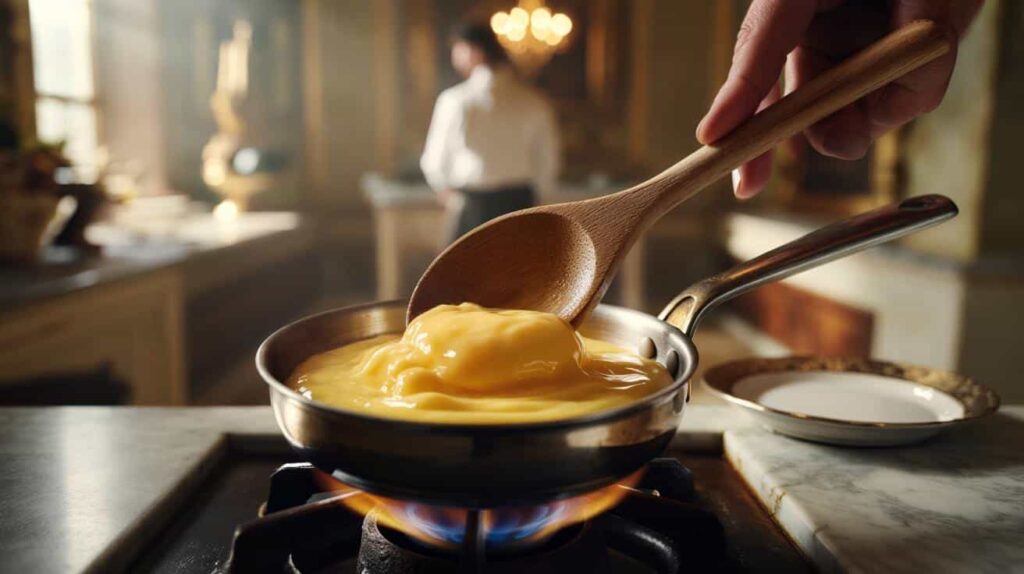
No drama, no cheffy flair. Just a small silver pot, a wooden spoon polished by years of stirring, and a flame turned so low it’s barely awake.
He doesn’t whisk in the air. He doesn’t drown the eggs in cream. He just breathes, stirs, pauses. The eggs move like slow lava around the pan, thickening in silky folds that look more like custard than breakfast.
A bell rings somewhere in the corridor of the palace. He glances at the clock, not in panic, but like a man who knows exactly how long softness takes. When the plate leaves the kitchen, the eggs barely wobble. They shine.
The secret, he says quietly, is not what you think.
The quiet luxury of “simple” eggs
Everyone swears they know how to make scrambled eggs. Whisk. Pan. Heat. Done in three minutes, usually while scrolling the news and burning the toast. Then you sit down and the eggs already look tired: watery patches, rubbery bits, a faint smell of overcooked sulfur.
The palace chef I watched was doing the same basic thing, yet the result felt like a different food group. No frills on the plate, no garnish shaped like a flower, just a small golden cloud that held its shape like a softly set pudding. *It was the kind of breakfast that makes you speak more quietly without knowing why.*
We like to think luxury means truffle shavings and rare ingredients. Here, luxury was time. And focus.
Years ago, a British survey found that scrambled eggs were in the top five “comfort breakfasts” people turn to on stressful mornings. They’re fast, cheap, and reliable. Which is probably why most of us treat them like background noise while making coffee or packing a school bag.
One palace footman told me guests often send back notes about the eggs much later in the day. Not the caviar, not the champagne, but *the eggs*. “They write that it tasted like something from their childhood, but *better*,” he laughed, almost embarrassed by how proud that makes the kitchen team.
On a state visit, a famously fussy VIP reportedly asked for the recipe. The chef smiled, wrote something on hotel stationery, and folded it closed. The note had just six words: “Low heat. Stir. Take them off early.” That’s all.
So why doesn’t every home cook do it like this? Part of the answer is that palace kitchens are built for patience. They have staff, mise en place, and no one yelling for teams on a video call in the next room. In a small flat with a single pan and a hungry teenager hovering, eggs become a practical task, not a tiny ritual.
The real divide isn’t skill, though. It’s mindset. We treat eggs as “easy” food, so we rush them. And eggs notice. Protein tightens, moisture runs, and suddenly that three-ingredient miracle tastes like school canteen nostalgia, in the wrong way.
What palace chefs have, beyond training, is a stubborn refusal to hurry the gentle things. Scrambled eggs sit firmly in that category.
The palace-chef method, step by step
Here’s the method the royal brigade uses on quiet mornings, stripped back so it works in a small kitchen. Crack 2–3 very fresh eggs into a bowl. Add a small pinch of salt and a twist of black pepper. No milk. No water. If you want to go full palace, add a teaspoon of cold butter in tiny cubes, straight into the eggs.
Whisk with a fork just until the yolks and whites are married, not frothy. Put a small saucepan or tiny nonstick pan on the lowest heat your hob can manage. Drop in a knob of butter and let it melt slowly, without sizzling. Pour in the eggs and start to stir with a spatula or wooden spoon, scraping the bottom constantly, as if you’re drawing lazy circles.

After a minute or two, the eggs will thicken from liquid to a glossy, custardy texture. Turn the heat off before you think they’re ready. The eggs should still look slightly too loose. Off the heat, keep stirring for 20–30 seconds. Then, and this is the royal non‑negotiable, slide them straight onto a warm plate. No waiting in the pan “for a second”.
Most people ruin scrambled eggs in three classic ways: too much heat, too much dairy, and too much distraction. High heat gives you speed, but it punishes the proteins. The result is curds that squeak and weep liquid. That’s why your eggs sometimes leave a sad yellow puddle on the plate.
Adding loads of milk or cream feels indulgent, yet it often just dilutes the flavour and makes it harder to judge doneness. The palace chef told me he’d rather start with good eggs and a tiny bit of butter than fancy cream and supermarket eggs. Soyons honnêtes : personne ne fait vraiment ça tous les jours, but choosing decent eggs twice a week is realistic.
The last enemy is your phone. Eggs have their own tempo. Look away for 30 seconds to fire off an email and you’ve missed the narrow window where they’re luscious, not lumpy. *One trick: cook them when nothing else needs your hands for three minutes.* It sounds small. It isn’t.
At one point, watching the chef stir in slow, careful loops, I asked if he ever got bored of making scrambled eggs for people who might not even notice. He didn’t stop stirring.

“You never know which plate will be the one they remember,” he said. “So every plate gets the same respect.”
That attitude translates surprisingly well to a weekday kitchen where the “VIP” is a toddler who only eats yellow food, or you, standing there in yesterday’s jumper wondering how to start the day. The technique is simple enough to repeat, even half asleep, once you’ve felt the right texture in the pan.
- Use very low heat and a small pan for control.
- Salt the eggs before cooking so the seasoning is even.
- Stir slowly but constantly, scraping the bottom and edges.
- Take them off the heat while they still look slightly too loose.
- Serve immediately on a warm plate, not from the hot pan.
Why these eggs feel like a small act of kindness
There’s a quiet, almost old‑fashioned comfort in starting the day with food that’s been treated gently. In a palace, that might be protocol. In an ordinary kitchen, it can feel like rebellion against the rush. On a bad morning, a plate of ultra‑creamy scrambled eggs eaten slowly over the sink can reset something in your head that coffee alone can’t reach.
We all know the moment when you sit down, finally, and realise the food you’ve just made tastes like you didn’t quite care. The palace-chef method doesn’t demand expensive gadgets or a spare hour before work. It asks for three extra minutes and a bit more attention. That’s all. The payoff is out of proportion to the effort.
And once you’ve tasted eggs that soft, it’s hard to go back. You might start timing your toast so it’s ready at the same second as the eggs. Maybe you’ll keep one “egg pan” you never use for anything else. Maybe you’ll quietly show a friend the trick one Sunday and watch their face when the first forkful lands.
The method spreads like that: plate by plate, kitchen by kitchen, in small acts of everyday luxury that nobody posts but everybody remembers.
| Point clé | Détail | Intérêt pour le lecteur |
|---|---|---|
| Cuisson à feu très doux | Panier sur la plus petite flamme, œufs cuits lentement en remuant sans cesse | Obtenir une texture crémeuse sans effort technique complexe |
| Retirer les œufs tôt | Les sortir du feu alors qu’ils paraissent encore un peu trop coulants | Profiter de la chaleur résiduelle pour atteindre le point parfait, sans les surcuire |
| Traitement “palace” au quotidien | Quelques minutes de concentration et des gestes simples, répétés | Transformer un petit-déjeuner banal en rituel réconfortant et mémorable |
FAQ :
- Can I use milk or cream in palace-style scrambled eggs?Yes, but in tiny amounts. A teaspoon or two of cream per egg is plenty. The texture comes mostly from low heat and timing, not from lots of dairy.
- Do I need a nonstick pan for this method?No, but a small nonstick or very well‑seasoned pan makes it easier. The key is constant stirring and low heat so the eggs don’t grab and stick.
- How long should scrambled eggs take with this technique?Usually 3–5 minutes on very low heat for 2–3 eggs. The exact time depends on your hob and pan, so watch the texture more than the clock.
- Can I add cheese, herbs or smoked salmon?Yes. Fold extras in right at the end, off the heat, so the eggs stay soft. Strong flavours like cheese or salmon need only a little to shine.
- What if my scrambled eggs turned out dry and rubbery?That means the heat was too high or you left them on the stove too long. Next time, lower the flame, stir more, and take them off while they still look slightly underdone.