
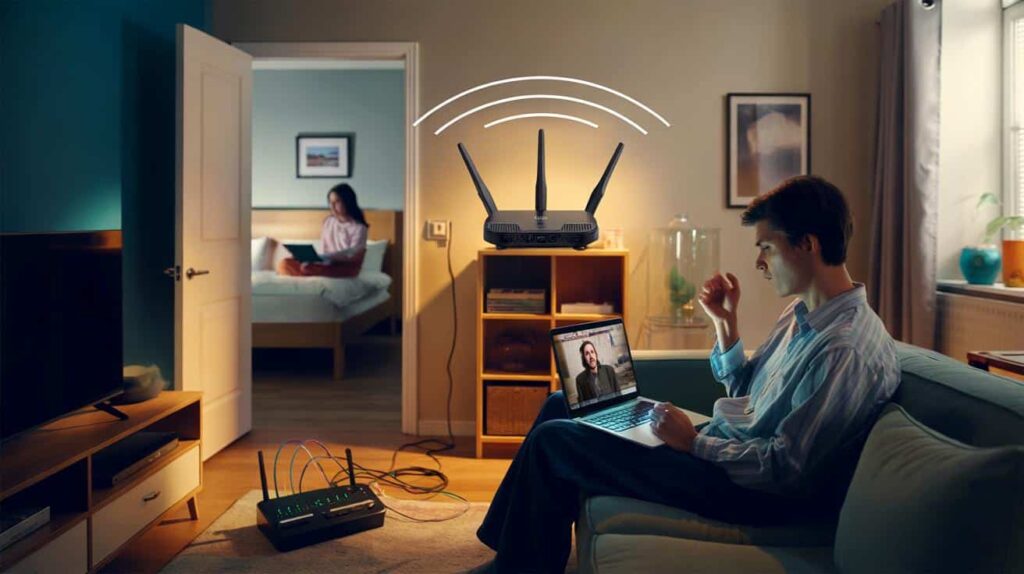
Glossy mesh nodes on shelves, a booster in the hallway, Ethernet cables coiled like snakes nobody dared to touch. And still, the Wi‑Fi wheel spun. Netflix stuttered, the Zoom call broke, someone shouted “Who’s downloading again?” from the kitchen.
Then something almost stupidly simple happened. The router was unplugged from its sad spot on the floor behind the TV, and placed one metre higher, on top of a bookcase. Same box. Same plan. Same walls. Yet the speed test graph suddenly shot upwards like a winning stock.
That tiny change cost nothing. The booster had cost a small fortune.
Why does one metre matter more than another box full of blinking LEDs?
Why height quietly beats hardware
If you walk through a typical British flat, you can almost guess where the router lives without seeing it. Low down, jammed behind the telly, next to the phone socket, surrounded by wires and dust. It’s the Wi‑Fi equivalent of parking a car in a ditch and wondering why it can’t go very far.

Radio waves hate that kind of life. They spread better when they “see” the room, not when they’re buried under MDF, plaster and a 15‑year‑old DVD player. Raise the router by a metre and the signal stops clawing its way around furniture and starts gliding through air. *Same device, different physics.*
This is why some people swear an “expensive” booster did nothing for them. The booster was fine. The placement was awful.
Ask around at work and you’ll hear the same story on repeat. Someone tried three different boosters, another paid for a mesh system “like the one from the advert”, and someone else begged their provider for a new router. The hidden detail is rarely the brand; it’s where the box actually sits.
One broadband engineer I met kept a mental map of bad router spots. On the floor behind a sofa. Inside a TV cabinet. Next to the microwave. Beneath an aquarium. In every case, the signal was being strangled before it even left the room. He’d lift the router onto a shelf, about eye level, run a speed test, and watch jaws drop.
Numbers back this up. Consumer tests in UK homes often show a 20–50% speed jump simply by moving the router higher and into the open. No app, no new contract, no shiny gadget. Just gravity, reversed.

The logic is boringly simple, which is probably why we ignore it. Wi‑Fi travels in all directions, but it likes clear paths. The higher the router, the less it has to punch through tables, radiators and your neighbour’s reinforced floor. Think of it like a tiny radio mast: when it’s low, every object becomes a wall; when it’s high, rooms start to connect in straight lines.
An expensive booster thrown into a bad layout just repeats the same mistake. You end up amplifying a poor signal, or bouncing waves around corners that were already killing your speed. Lifting the original source often fixes 70% of the problem before you buy anything at all.
How to use that “one metre trick” at home
Start with a walk. Phone in hand, Wi‑Fi analyser or speed test app open, just move slowly around the room where your router lives. Notice where the connection feels solid and where it suddenly sags. That’s your invisible map of obstacles.
Then unplug the router, free it from the cable nest, and look up. Find a spot roughly chest to head height: top of a bookcase, sturdy shelf, even a wall‑mounted bracket if you can. Keep it out in the open, with air around it, not pressed flat against the wall. Plug it back in, let it reboot, and repeat your little indoor walk.
The change often feels ridiculous. Pages snap open. The “unstable connection” warning quietly vanishes.

This is where the human part kicks in. We hide routers because they’re ugly, and we leave them where the engineer installed them because moving cables feels like surgery. We also massively underestimate walls. One solid brick wall with pipes inside can chew through your signal far more than the distance between two rooms.
Try to keep the router roughly central to where people actually use Wi‑Fi, not where the phone socket happens to be. Hallways and landings can be surprisingly powerful, especially in narrow UK houses. And don’t be afraid to use a slightly longer cable from the socket; it’s not a crime against broadband.
Soyons honnêtes : personne ne fait vraiment ça tous les jours, mais one decent repositioning session can change your daily life with the broadband you already pay for.
Some readers only believe it when they hear someone else say it out loud.
“I spent £150 on a booster kit,” a London renter told me, “and my Wi‑Fi was still rubbish in the bedroom. Then my cousin came over, put the router on top of the wardrobe, and it went from 8 Mbps to 70. I felt both relieved and slightly offended by physics.”

That mix of relief and annoyance is very common. We’re sold speed in megabits, not in metres and centimetres.
- Place the router 1–1.5 metres off the floor, in the open
- Keep it away from metal objects, fish tanks and thick masonry
- Point antennas (if you have them) half vertical, half angled
- Test again from your worst room before buying any booster
When height wins, and when you really do need more kit
One metre higher won’t turn a 5 Mbps rural line into fibre. Physics has limits. What it does is give you the best version of the connection you’re already paying for, before you throw money at boxes that might just mask a bad layout.
Think of it as a reset. Once the router is high, central and free from clutter, any other upgrade you choose — booster, mesh, new contract — actually has a fair chance to shine. You’re no longer patching over avoidable mistakes.
In long, narrow houses or thick‑walled cottages, you may still need extra help. That’s fine. The trick is to test the “height rule” first, share a couple of speed tests with the family, and treat hardware as the last step, not the first impulse.
| Point clé | Détail | Intérêt pour le lecteur |
|---|---|---|
| Hauteur du routeur | Le placer 1–1,5 mètre au-dessus du sol, en position ouverte | Gagner en vitesse et stabilité sans rien dépenser |
| Éviter les obstacles | Éloigner le routeur des murs épais, meubles massifs et appareils électroménagers | Réduire les pertes de signal invisibles au quotidien |
| Booster en dernier recours | Tester d’abord le positionnement, puis envisager booster ou mesh | Éviter les achats inutiles et les fausses promesses marketing |
FAQ :
- Does raising my Wi‑Fi router really make that much difference?In many homes, yes. Tests often show a 20–50% improvement simply by lifting the router about a metre and moving it into the open.
- Is a booster useless if my router is badly placed?Not useless, but far less effective. You might just be amplifying a weak, obstructed signal instead of fixing the root cause.
- Where should I avoid putting my router?Inside cupboards, behind TVs, on the floor, next to microwaves, or right against thick brick walls and metal objects.
- What if my phone socket is in a terrible spot?Use a longer, good‑quality cable from the socket to the router, then place the router higher and more central in the room.
- Do the router antennas need a special angle?If you have external antennas, keep at least one vertical and one slightly angled to help spread the signal more evenly across floors.