
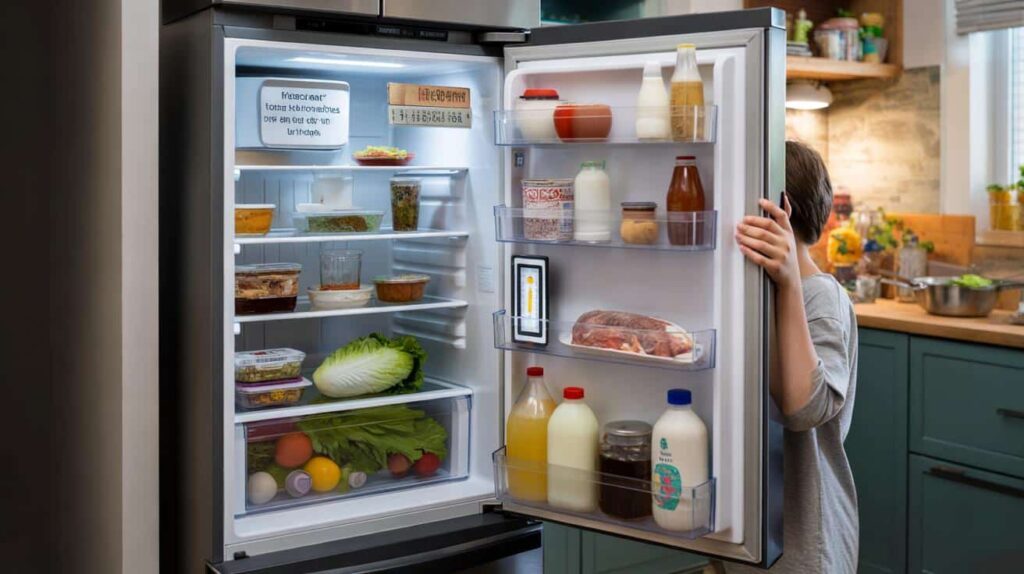
By lunchtime, it had that faint sour smell that makes you doubt your entire fridge. You glance at the factory sticker still inside the door – 4°C, the “safe” setting, untouched since installation. Everything should be perfect. Yet the lettuce turns limp way too soon, the milk sometimes froths oddly in your tea, and frozen chips gather snow inside the packet.
You start touching things like a detective: the back wall is icy-cold, the door shelves feel almost room temperature. The light goes off, the motor hums, you close the door a bit harder, as if that might fix something deep in the machine’s brain.
On paper, your fridge is set exactly as the manufacturer wanted. In real life, your food is telling a very different story.
When “factory settings” meet real kitchens
Stand in front of any brand-new fridge in a showroom and it looks like a promise: clean shelves, perfect light, a little dial set lovingly to the “ideal” temperature. Then it arrives in your home, meets your cluttered worktop, your kids opening the door every ten minutes, your weekly big shop, and that promise starts to wobble.
Factory settings are based on controlled lab conditions. Stable room temperature. Door opened a set number of times. Shelves neatly spaced. Real kitchens are messy, warm, busy, and full of half-finished leftovers. So the number written on the sticker suddenly means a lot less than it seems.

That’s why a fridge “set to 4°C” can, in practice, swing from near freezing at the back to 9°C in the door. The label hasn’t lied. Life has simply interfered.
Food safety bodies in the UK often warn that a shocking share of home fridges run too warm. Surveys by consumer groups have found average domestic temperatures drifting well above the recommended 5°C. People think they’re fine because they’ve never changed the dial. The myth is powerful: *if I haven’t touched it, it must be correct*.
One London family I spoke to had the classic set-up: big weekly supermarket delivery, packed fridge, door opening constantly for snacks. Their milk kept going off two days early. The dial sat calmly at the middle factory mark. When they finally put a cheap fridge thermometer on the middle shelf, it hovered around 8°C most afternoons.
Their mistake wasn’t carelessness. It was trusting the factory setting to magically adapt to their life. The fridge was doing what it was told; it just wasn’t told the full story of that busy kitchen.
Once you start breaking it down, the logic is simple. Factory settings are a starting guess, not a guarantee. The cabinet’s true temperature depends on room heat, how full it is, air flow, how long the door stays open, whether it’s squashed into a tight alcove with no ventilation, even whether the fridge is level. Sensors often sit in a specific spot, so they “think” the fridge is at target temperature while your food sits warmer at the front or in overloaded door shelves.

Then there’s the dial itself. Many models don’t even show °C, just numbers from 1 to 5 or 1 to 7. People assume “3” equals “4°C”, but it rarely works like that. It’s more of a power level than a fixed temperature. The fridge cycles on and off to hit an internal setpoint that may not match the glossy brochure. In other words: your fridge’s brain lives in a different reality to your cheese.
How to actually know what temperature you’re dealing with
The single most useful move is boring but powerful: put a separate thermometer inside the fridge. A simple, cheap analogue or digital one, placed on the middle shelf, not pushed against the back wall. Leave it there at least overnight. Look at it at different times of day, especially early evening when the fridge has been working hard.
If you want to go one step further, move the thermometer around for a couple of days. Middle shelf. Then door. Then the bottom, just above the salad drawers. You’ll probably discover you don’t have “a fridge temperature”, you have several micro-climates. Back corners may hover just above freezing. Door shelves, particularly high up, can be almost as warm as your kitchen during cooking time.
Once you see those numbers, the factory setting stops being a comfort blanket and becomes a rough suggestion.
Most brands quietly know your fridge won’t live in a showroom, which is why manuals are full of small-print advice nobody reads. Door shelves are where the biggest lies happen. People keep milk there because it’s easy to grab. It’s also the warmest place, hit with a burst of hot air every time the door swings open.

On top of that, many of us overload the fridge. Boxes stacked to the ceiling, foil-wrapped leftovers pushed right up against the back, salad crammed under anything that fits. Cold air can’t circulate properly, so you end up with “cold shadows” and unexpectedly warm pockets. Soyons honnêtes : personne ne fait vraiment ça tous les jours, cette vérification méticuleuse des zones froides et chaudes.
If your fridge is crammed, the compressor works harder and runs longer, yet some areas still stay too warm. That’s how you get the odd paradox of ice crystals on lettuce at the back, while raw chicken on the front edge sits at unsafe temperatures. It feels like the fridge is broken, but in many cases, it’s simply suffocating.
One engineer I interviewed put it bluntly:
“Factory settings are a bit like the default ringtone on your phone. Technically fine, but not really adapted to your life until you tweak it.”
There are a few quick “fridge reset” moves worth trying over a single weekend:

- Pull the fridge gently away from the wall to give it breathing space.
- Check the door seals with a sheet of paper to see if they grip properly.
- Throw out long-forgotten jars and leftovers to free air flow.
- Shift milk and meat off the door and onto the inner shelves.
- Lower the dial by one notch, then re-check with a separate thermometer after 24 hours.
These steps sound tiny. Combined, they can swing the mean temperature by several degrees without buying anything new. Your “factory setting” suddenly works better, only because the factory scenario now slightly resembles your actual kitchen.
The bit nobody tells you when you plug it in
There’s a quiet, slightly guilty moment many people know: you throw out food that “shouldn’t” have gone off yet. You feel wasteful, a bit annoyed, maybe vaguely worried about that chicken salad you ate two days before. On a bad week, it can feel like the fridge is sabotaging your good intentions to eat better and spend less.
What’s rarely said aloud is this: a modern fridge is designed for someone who reads the manual, cleans the coils, checks the door seals, leaves space around the cabinet, never overloads it and lives in a home at a stable 20°C. That ideal person barely exists. Real people lean heavy shopping bags against the door, tuck the appliance into a tight corner, and squeeze in one more takeaway box “just for tonight”. The factory doesn’t design for your late Sunday night fridge-Tetris.
In that gap between the ideal user and the real one, your temperature quietly drifts.
Once you accept that, the fridge turns from some mysterious failing gadget into something more like a fussy colleague. It has rules. You don’t need to follow all of them, just the ones that matter. Store raw meat and milk on the coldest inner shelves, usually low and at the back. Use the door for jams, sauces, butter, drinks – items that forgive a little warmth. Leave a small gap around containers so air can move. Wipe obvious dust from the back grills every few months to stop the system overheating.
None of this needs to become a new religion. *You’re allowed messy weeks.* But every small change shifts the daily average temperature closer to where the factory originally hoped it would be. Your fridge stops being “wrong”, and becomes honestly predictable.
From there, the conversation changes. Instead of wondering if you should replace an apparently faulty appliance, you start asking different questions. How warm does the kitchen get when you cook? Is the fridge crammed after each big shop in a way that forces the door to stay open longer? Does your teenager stand there with the door wide open scrolling on their phone? These very human habits bend whatever the factory dial says.
And once you spot them, you can bend things back.
| Point clé | Détail | Intérêt pour le lecteur |
|---|---|---|
| Factory settings are only a starting point | They’re based on lab conditions, not real homes | Explains why food spoils even when you “never touched the dial” |
| Use an independent thermometer | Place it on the middle shelf and check different areas | Gives a truthful picture of what your food actually experiences |
| Small habits change real temperature | Door openings, overfilling, poor ventilation and seal issues | Shows concrete actions that can make your fridge safer and more efficient |
FAQ :
- What temperature should my fridge really be?Most food safety experts recommend 0–5°C, with many targeting about 4°C as a good balance between safety and avoiding icy patches.
- Why does my fridge feel cold, but food still goes off quickly?Parts of the cabinet can be cold while door shelves or the front of packed shelves sit several degrees warmer, especially in busy households.
- Is it safe to keep milk in the door?It’s convenient, but the door is usually the warmest zone. Storing milk on an inner shelf helps it last closer to the date on the bottle.
- How often should I check my fridge temperature?Once you’ve dialled it in, a quick glance at a thermometer every few weeks, plus after big seasonal changes, is usually enough.
- Do I need a smart fridge to get accurate temperatures?No. A basic fridge, given breathing space and a simple internal thermometer, can be just as reliable as a fancy connected model.